Saturday, January 26, 2013

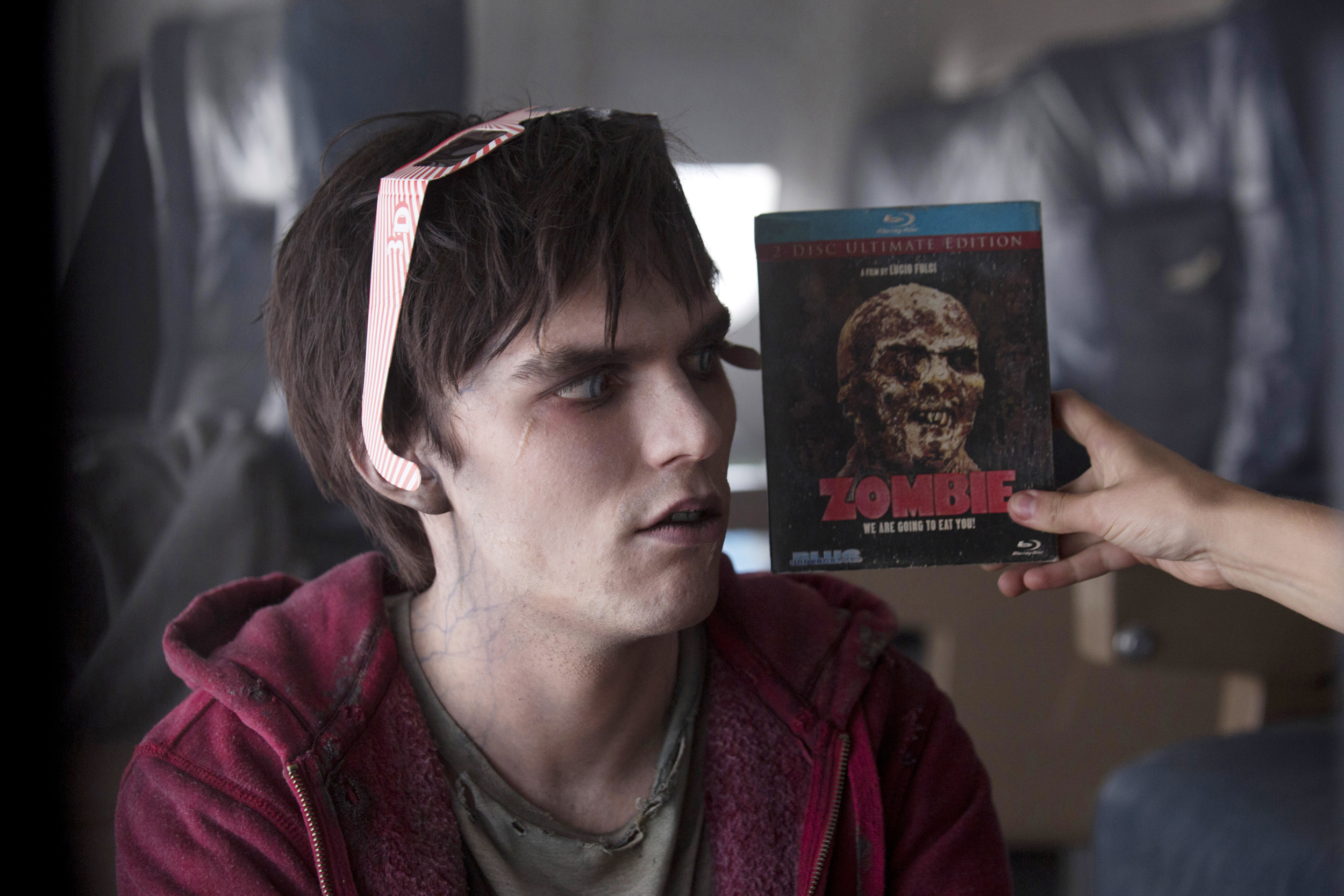
"Warm Bodies" Review: Zombies Gone Hipster


It's not the best zom-com ever made. Certainly films like "Zombieland" and "Shaun of the Dead" take that prize. But, with a razor sharp, relatively inventive script/story, and a great performance from Nicholas Hoult, it's honestly not half bad.

"Warm Bodies" centers on a self-aware zombie, named R (Hoult), who cannot speak or control his urges. He spends his days at an airport, droning, groaning, and invading nearby cities in search of humans for food with the rest of his zombie horde. But, deviating from the rest of the zombie subgenre, the audience is in treated to R's narration. And surprisingly, we find out how remarkably self-aware he is. R feels conflicted about the things he does, he feels emotions, loneliness, appreciates good music and unique relics of the pre-zombie apocalypse world, and above all, simply longs to remember what it is like to be human. Then one day, uncharacteristically, he meets and falls in love with a survivor of the human resistance, Julie (Teresa Palmer), and R decides not to kill her, but rather save her. During his mission to save Julie from some "far-gone" zombies called "Bonies," R begins changing and becoming more human, which causes other zombies to follow in his example, leading to a major change in the war between humans, zombies, and "bonies."

It is a very unusual premise, I know. And the way it sounds, makes it appear Twilight-y. But fear not. It's at least more intelligent. If nothing else, I need to give it mad props for originality and cleverness of the writing. The movie has some funny moments and sharp snark to it--particularly R's entire narration. Hoult's comedic timing and self-conscious nervousness shines through, giving us the closest thing to a zombie Woody Allen (only, you know, more emo) that we've seen in a film. The beginning narration is probably the most smile-inducing moment in the movie, because it's so fresh. It sets you up for the great point of the movie-- giving zombies personality and humanity--and sets us up for the movie's overall theme of exploring what it is and means to be human. R's a well-rounded character. In fact all the zombies are, from R to R's best friend M (Rob Corddry), and beyond. And we are invested in the characters because Hoult and Corddry makes them likable and sympathetic. And the pieces of zombie backstory writer/director Jonathan Levine (50/50) treats you to allow us to identify with the characters and their desire to be human again. Admittedly, yes, you do get a little tired of the fact by the end of the movie, because it gets a little stale given the one-joke premise (insecure zombie), but at least its heart is in the right place.  

As mentioned Hoult and Corddry are great. And as far as other performances go Analeigh Tipton (Crazy Stupid Love) gives the next funnest performance in the film, as Julie's reasonably amusing and funny best friend. But the other supporting performances just aren't up to par with Hoult's anchor of a character. For example, Teresa Palmer is actually quite bland as Julie. Apart from aesthetics, I really don't see what R sees in her character. Also, surprisingly, John Malkovich isn't really anything to write home about either. He's sort of phoning it in as Julie's father, leader of the human resistance against the zombies, who's uncompromising and unwilling to change his beliefs that zombies can change back into humans (uh...when you say it like that, who really could blame him right?). Essentially he's playing the tough-guy John Malkovich, we've seen in all other films he's been in, only in an apathetic sort of way--unlike, say, his fun performance as the paranoid Marvin in Red, or even his own meta-performance as himself in Being John Malkovich. We get bits and pieces of Dave Franco (literally when R sort of chews on bits and pieces of him to feel his memories), and while there's a sweetness to his character, I'm starting to think young Dave is not as versatile as his older brother James. His character's a bit of a sweeter version of the character he played in 21 Jump Street--only, you know, in the zombie apocalypse. There is one scene that contributes a lot of character development to Franco's character, and that's the scene where he's forced to watch his zombie father being gunned down by his girlfriend. The character then changes into a soldier completely. It's a well written change for a minor character, but you aren't able to feel any of it with the way Franco sells it. A bit of a pity, really.

Speaking of "pity," the direction isn't all that great either. Levine has written a fun, interesting script, but he's hardly making things fun on screen. Everything is sort of blandly shot and executed, to the point where, despite the fact that you could feel there's a better movie in the words, characters, and actions, you don't really care much by the end of the film. I left not really feeling or taking very much with me, despite the fact that I initially was enjoying it. In other words, rather than making an impact on the audience with the direction, as Ruben Fleischer did with his visuals and comedic timing in Zombieland, we more or less just shrug "Warm Bodies" off. And there's something wrong with that, because, in essence, this is an original movie that's kind of the first of its own in its subgenre (in terms of having self aware zombies). He also injects heavy, heavy amounts of quirk into the film, which sometimes makes the movie feel like it's trying too hard to be way too offbeat and a little "too cool for school." We have zombies, and they are so cool, they listen to vinyl because "sound...better." Really? Did we need to make our zombies hipsters? (Admittedly, it does have a nice soundtrack though). Again though, there are some pretty funny moments--for example the scene where R watches Julie taking off her shirt while they prepare for bed in an abandoned house, and another ridiculous homage to Romeo and Juliet's famed balcony scene, between R the zombie and Julie. But in my opinion, I think the movie could have used more humor and pathos, and a bit less romance. 

Nevertheless, there's an innate sweetness to the film, and when it's comedic, it's often good material, even if it is trying too hard to be offbeat. The heart and comedy, along with a good, original script, and a great performance by Nicholas Hoult make the film acceptable overall. Though the other performances aren't great, and though the movie doesn't really resonate with you after, I'd say it's still a nice enough little excursion to the theatre on a boring Saturday afternoon (or a Netflix stream if you end up being lazy...I could see this as a good rental movie honestly).  And hey, at least that's more than we can say about most supernatural teen romances, right?

Overall Rating: B

"Gangster Squad" Review: or The "Un-"Untouchables


Back in 2009, Ruben Fleischer made his directorial film debut with one of the best movies in the zombie sub-genre with the refreshingly hilarious and fun Zombieland. Probably my favorite zombie movie of all time. Fleischer treated it with really fun unconventional visuals (like zombie-rules being posted on screen, pianos dropping on zombies, etc.) and the ability to command great chemistry between his ensemble. (Oh yeah. And Bill Murray's brilliant cameo certainly didn't hurt!) Under his guidance, the film garnered a 90%--most of the reviews praising his direction--on Rotten Tomatoes and $102 mil worldwide, on a budget of about $25 mil. It was the promise of a budding, brilliant career from a very strong visual director with a good sense for comedic timing. Fleischer has had 2 movies since Zombieland. And all I have to say is...

What the hell happened???

Between the terrible 30 Minutes or Less and this, I suppose the fanfare was premature. Once upon a time Gangster Squad was set to be released in September 2012. Most September movies aren't great, but they're typically not as bad as films released in January, when some of the worst films on a studio's slate are tragically dumped. Then the release date got shifted to January. And guess what folks--it lives up to the title of January crap-fest.

The movie has a shoe-string thin plotline--The LAPD puts together an off-the-books ragtag group of vigilante misfits to take down Mickey Cohen (Sean Penn), a ruthless mafia boss/former boxer who's slowly but surely tightening his control over the City of Angels in the 1940s. That's it.

Now a movie like this with a plotline so limited can be easily salvageable if the movie is fun. But Gangster Squad is so boggled down with cheesy cliches, over-the-top ridiculous acting (particularly on the scene-chewing Penn's part), that the amount of bland, recycled action sequences that occur just don't compensate for the clumsy, half-assed approach to filmmaking that Fleischer has on display for 2 hours. And I'm not asking for the film to be new or innovative, but literally every second of the film seems to be ripping off a better film before it--particularly De Palma's The Untouchables. The final shoot out in Cohen's hotel is essentially a rip off of the infamous staircase shootout (minus the bouncing baby carriage of course).

In fact, if you even break down the individual members of the Gangster Squad, we're treated to lame knockoffs of the exact members of the Untouchables. We split Kevin Costner's Eliot Ness into the tough no-nonsense straight arrow beat cop (Josh Brolin's character) and handsome, slick, emotional younger cop (Ryan Gosling). The team has an intelligence man (Giovani Ribisi) who figures out Cohen's schemes through his genius, but ends up biting it midway through, just like accountant Wallace from The Untouchables. And they have 2 sharpshooters--an aged veteran (Robert Patrick), and a newbie Latino gunman in training (Michael Pena)--obviously variations of Andy Garcia and Sean Connery's characters. And of course, Sean Penn--revered acting veteran--playing a tough as nails, ruthless murdering gangster--shades of them trying to copy DeNiro's Al Capone.The only characters without real doppelgangers from the Untouchables are Emma Stone's character and Anthony Mackie's. Stone's trying hard to fit the 40's femme fatale persona, and does a good job of it. It's just a pity the rest of the movie isn't trying as hard as she is. While Anthony Mackie's character is merely there as a token black guy who's good with knives. There really isn't anything further with his character other than that.

Apart from the fact that the characters were ripoffs, the movie itself is ridiculously cheesy. It's also schizophrenic. Allow me to explain both. Cheesy: We are treated to such sloppy, terrible writing. Characters spit out  lines like "When I came here I was nothing,back home I was a gangster, now I'm GOD" or "We're not solving a case here. We're going to war!" Everything in the film is a ridiculous cliche of obvious lines without a sense of originality or intelligence. There's even a terrible scene where Ryan Gossling's decides it's time for vengeance against Mickey Cohen because of the "tragic" death of his shoeshine boy street sidekick. Pathetic. Schizophrenic: The movie doesn't know if it wants to be serious or not. We start out with some pretty grisly violence. Then it randomly veers into some unnecessarily slapstick scenes of the Gangster Squad's failed attempts at a casino robbery and a jail break. Moments like this completely do not fit with the tone of the rest of the movie. So the whole time, we, the audience, are left wondering whether this is supposed to be a pulpy noir-ish mobster movie, ala Untouchables, or a semi-parody of the genre due to the hilariously idiotic choices made by characters.

Just to go off on a minor tangent, what's really disappointing is the terrible screenplay is written by the man who's contracted to do the Justice League movie (first-timer, Will Beal). Dear lord, I can only imagine how terrible that's going to be now.

But I digress. The only real saving grace of the movie, maybe, is the look and art direction. It really does fit in with the best neo-noir pulp films set in the 1940s. But unfortunately, good visuals does not a good movie make--and they're not even that great, as far as most movies nowadays are concerned.

All in all, there's really not a whole lot about this movie that's redeemable. The whole thing is a trite exercise in Monkey-See, Monkey-Do. I mean seriously, I'm a fan of "turn your brain off" fun blockbuster types, but it's more fun when it's something you haven't seen before, or at least has a serviceable story I can get behind. When it's almost an exact replica of another, superior movie beat for beat, only done in a much poorer way, it's simply a waste of time, money, and talent.

Overall Rating: D+

Thursday, January 3, 2013

"Les Miserable" Review: Wolverine Vs. Gladiator with Much More Singing And French People Who Sound British


Sorry folks. Couldn't resist the goofy title. 

The modern day movie-musical is a very delicate sub-genre to tackle. In many cases across the 00's you have movie musicals that prioritize singers over actors (see Dreamgirls). In other cases you have movies that tend to prioritize actors over singers (see Mama Mia). With the former you have what I call "singing with feeling" only (Jen Hudson may have won an Oscar, but to me that wasn't acting. It was very passionate singing), whereas with the latter you just have really terrible attempts at singing (I'm looking at your Pierce Brosnan). Where Les Mis succeeds over most movie musicals is that it benefits from skilled actors who have very spectacular voices. Not since Moulin Rouge have I seen such a good blend of acting and singing, but unlike Moulin Rouge, the entire ensemble is reasonably fantastic at both (not just Ewan Mcgregor)! THAT is Les Mis's strongest asset. The performances drive the film completely, in spite of some questionable directing choices and lack of risk-taking from director Tom Hooper.

Now Les Mis is a very long, very complicated story. I mean it ought to be considering the original text is like 1,488 pages. Jean Valjean, a prisoner serving out a 20 year sentence for stealing a loaf of bread to feed his family is paroled, but pursued constantly but Inspector Javert across several years after breaking that parole. Through those years Valjean makes a vow to God to become a better person as he inherits a position as the Mayor of a city, makes a vow to a dying factory worker to adopt and care for her daughter, and raises her daughter during the political unrest of France during the June Rebellion. We are introduced to several characters and more complex situations, all while watching this innocent man continue to dodge the ruthlessness of the law. In general, it's quite heavy on the melodramatic elements. I mean they wouldn't call it "The Miserable Ones" if it wasn't about bad things happening to miserable people right? But regardless, you're invested in the plight of our heroes because the circumstances in which they are led to be miserable aren't warranted (they're good characters overall) and because our actors who can sing are definitely selling it. 

Now I liked the movie a lot. But it is a chore to sit through. The entire screenplay is sung through from beginning to end, apart from, maybe, 30 words un-melodically spoken throughout a 3 hour film. If you are not accustomed to musicals, beware, because this one is a huge doozy. However, as stated before, the entire cast is game. Hugh Jackman has definitely secured himself his first Oscar nomination. As Valjean, his performance is breathtaking. Jackman is such a naturally great singer, with the ability to hit so many great, long, high, complex notes. I knew he was good, but I had no idea before seeing this film that he was great. But what's even better than the singing is his emoting. Jackman does more than just sing passionately. We feel Valjean's kindness, determination, desperation, mercy, etc, coming from Jackman's incredibly expressive performance, facial cues, mannerisms, etc. He's not just singing. He's reacting, and you can see it all in his eyes and facial changes/glances/looks, along with the subtle changes in the intonation and volume of his voice while singing. It's honestly just very brilliant acting. Anne Hathaway is most definitely a highlight as well. If Jackman is secured a nomination, Hathaway is secured a win. Like Jackman, her emoting and reacting to the situations happening to her, through song or otherwise, is raw, tragic, and powerful. Her performance of "I Dreamed a Dream" is the definitive centerpiece of the film--something the marketers at Universal probably believed as well, considering it's a) arguably the musical's signature song, and b) basically the entire teaser trailer. But you see Hathaway's performance, and you completely forget the song was ever covered by the likes of Susan Boyle. It is heartbreaking. I may also not that the sheer fact that both Jackman and Hathaway are particularly gifted at bringing real tears and real red eyes to their performances is particularly effective in getting the audience to want to cry with them. Commanding. Charismatic. Powerful. Both of them.

Now the rest of the cast fairs very well also. They may not be the highlights Hathaway and Jackman are, but we get some very solid performances from Eddie Redmayne as Marius, and Les Mis stage-alum, Samantha Barks as Eponine. The Marius/Eponine chemistry is completely fantastic--in particular the tear-inducing "Little Fall of Rain" scene. Barks, in particular, is great throughout her entire role, evoking the tortured sadness of a woman deeply, tragically, and one-sidedly in love with someone, knowing full well it would never be reciprocated. Barks makes you feel the sadness she's feeling, without ever coming across as bitter. She allows you completely to sympathize with the character. Granted Eponine in general is just a sympathetic character. But Barks' lonely expressions, subtle weeping--the cracks in her voice, the empty smiles at Marius indicating her overall facade to show him she's alright when she isn't--all get you invested in her plight completely. She becomes the easiest character to feel sympathy for after Fantine's death in the first act, thanks to Barks' performance. Redmayne, for the most part, starts off reasonably bland, only really showcasing his abilities as a singer, rather than an actor. However, this all changes after a lovely performance and excellent chemistry with Barks in the aforementioned "Little Fall of Rain" scene. From there, we are treated to Marius' big number, "Empty Chairs at Empty Tables." And Redmayne nails it. He's able to convey Marius' internal regrets, guilt, and woe about living while his cohorts have all died in a very expressive manner--vocally and physically. Next to Hathaway and Jackman, this duo and their chemistry come across as the next best reason to see this film.

The weaker links in the main cast are unfortunately Russell Crowe as Javert and Amanda Seyfried as Cosette. Seyfried's voice is pretty, if not a bit shrill, and her acting is fine. But for the most part she could have had the opportunity to do anything new or compelling with the role, which originally is actually an underwritten part, but I honestly didn't detect anything special about her performance. And unfortunately, while Russell Crowe does a fine job singing and acting, he pales in comparison miserably (see what I did there?) whenever he's on screen with Jackman. I feel like a lot of the reviews have been harder on him than they should be. Because in truth, hey, who knew Gladiator could sing as well as he does in this film. And naturally his performance in bringing Javert's dedication to the law to life is as good as you'd expect from a man used to playing a soldier. You get his mad dedication to the law, and his ruthlessness. But his singing is just not on par in terms of power with any other stage incarnation of the character on Broadway, nor is it on par with majority of the main cast. Considering that he's sharing the screen with the fantastic vocals and presence of Jackman, Crowe's performance ends up coming across as "good" rather than "great," and his singing, in the end, is really just slightly above mediocre. For minor-ish roles, Helena Bonham Carter and Sacha Baron Cohen provide some necessary comic relief as the sleezy Thenardiers. Their roles and singing ability is not unlike what we've previously seen them do in Sweeney Todd. And, it must be noted, Aaron Tveit as Enjolras, leader of Les Amis de l'ABC is also very fantastic. Tveit makes you believe the convictions of Enjolras' goals as a character in a similar way Crowe convinces you his character believes in his. The only difference here is that Tveit can actually sing very very well. 

However, the giant lists of performance positives aside, the biggest, worst problem with Les Miserables lies in Hooper's direction and cinematography. Where we, as an audience, should be transported to the immense, impoverished environment of post-revolution France, we get a giant close up of a character's face, with a shot that stays focused solely on the characters face, as if they're talking directly to the audience, rather than reacting to the situations going on or the world around them. This happens more than once in the film, particular examples being Hathaway's "I Dreamed a Dream" performance, Redmayne's "Empty Chairs" number, and several of Jackman and Crowe's songs as well. Despite the amazing performances of each, so much more could have been done to many of these scenes. I honestly don't think it would have killed Hooper to move the camera once in a while, or let the visuals set some sort of mood or motifs for the songs and situations in the story. It's especially disappointing given how amazing the sets and scenery look. The environment of 19th century France is incredibly well established on a technical scale, so why not emphasize the magnificent production design/aesthetic of the film? Why not let this environment enhance your characters and the performance? While letting your actors drive the raw emotion of a scene is important (hence I somewhat understand his decision to make this stylistic choice), there's nothing at all special about taking a camera and shoving it directly in front of someone's face, expecting them to sing and emote. Any 4-year old with a Super 8 handheld camera could do the same. In some cases it works (For "I Dreamed a Dream" I understand it's necessary to capture the broken, empty, lonely condition of what's left of Fantine's spirit and hope), but for many others, it de-emphasizes the impact of the musical numbers. And Hooper is capable of more than this. He got very animated for the "Master of the House" number, and "Do You Hear the People Sing." And, yes, he's not expected to be that animated for the less upbeat songs. But he really completely does nothing for many of them, other than remain stagnant on an actor's face for the entire number. In some cases, we even get some "shaky cam" moments to make the film feel raw, when it really doesn't need to. Raw is good in a movie, yes. But that cannot be the only tone or atmosphere conveyed in a movie musical of this magnitude, honestly. And there's a point where "raw" ends up feeling more like "You Tube." Having said that, there is one decision Hooper made that benefits the movie greatly: the decision to have the actors sing on set, rather than pre-record and lip sync. In a movie as musically driven as Les Mis, acting and emoting genuinely through the song is key because the songs are your script. Having the actors sing up front, on set, in real time brings so much more raw emotion and sincerity to the performances than most other musicals with pre-recorded, lip synced tracks. And for that, Hooper deserves praise.

As indicated before though, again, the performances are what really save this movie. The actors are able to make you believe in the story and disregard any contrivances or melodrama the story may have. They make you invested in their characters' situations with their strong voices and intense charismatic emoting, even if the writing feels overly dramatic at times. And they do this all in spite of some uninspired, and oftentimes lifeless directing on behalf of Tom Hooper. Granted, the way the film is cut together is actually beautifully done--but that's more of an editing win than a directing one. There are just opportunities that feel wasted in several instances throughout the film--for example, as beautiful as the chemistry was between Redmayne and Barks for "A Little Fall of Rain," we're quickly forced to "unfeel" the impact of the situation, since Hooper just decides to move on without really taking time to acknowledge the gravity of the tragic situation. But hey, again, regardless of the direction, at the end of the day (see what I did there?), I still think it's the best, most sweeping, reverent movie musical in at least a good decade. And, ladies and gentlemen, there's nothing miserable about that at all.

Overall Grade: B+

Thursday, December 27, 2012

"Django Unchained" Review: Mr. Tarantino--You Had My Curiosity. Now You Have My Attention!


God bless Quentin Tarantino. Now this, ladies and gentleman, is a director that's going to do whatever he wants to do, and does not give a crap what other people think every time. And because of that, the state of cinema is much better for it. 

As a hardcore Tarantino-fan, I feel a bit biased reviewing this one, simply because I figured I would like it anyway. But I honestly did not expect to love it as much as I did. Nevertheless, as bias probably comes into the picture, take my opinion here with a grain of salt.

"Django," much like "Inglorious Basterds" and "Kill Bill" is a revenge movie. As a revenge movie, it's a bit of a cross between the gritty tone of "Basterds" and the cartoon-like nature of "Kill Bill."The basic premise is simple: a slave named Django (Jaime Foxx) is recruited by a German bounty hunter named Dr. King Schultz (Christoph Waltz) to find a gang called the Brittle Brothers, who only Django has personally seen. Once they've killed the Brittle Brothers in a relatively short span of time, Schultz decides (being personally responsible for Django's freedom and feeling a strong opposition to the principles of slavery in general) to help Django rescue his wife from the clutches of nefarious plantation owner Calvin J. Candie (Leo DiCaprio).

The movie belongs to Waltz and DiCaprio. Both are incredibly charming, particularly Waltz, who acts a bit like Django's Obi Wan Kenobi. His earnest nature, and his affection for Django is something admirable in the film. Not to mention that watching how skilled he is as a bounty hunter is pure fun. It's really hard not to root for him, especially as his is the dominant voice of the White abolitionist in the film. Nevertheless the fact that he basically goes after and murders criminals still puts him in enough of a morally grey area, so he does not come off as a complete saint. On the "evil" side, DiCaprio does a magnificent job as the primary antagonist of the film, veering between charming, and completely bat-crap crazy and menacing (particularly during the climactic skull cracking scene). Jamie Foxx is, sadly, the weakest of the leads. That's not to say he isn't good, he's very good, he just loses his luster in the presence of such fantastic actors, like DiCaprio and Waltz. Foxx gets his moment to really shine in the last third of the movie, where his actual revenge is being conducted. But of course by then, Waltz and DiCaprio are out of the picture. Nevertheless, as far as gun-fu is concerned, Foxx's scenes are arguably the coolest, best-choreographed gun-fu scenes in cinema since Rodriguez's "Desperado" way back in 1995. So of course, given the fun action set pieces, you'll be rooting for Django every step of the way. On the supporting front, Kerry Washington plays our resident damsel in distress, which is a bit lacking in terms of character development, overall. But hey, at least she took the initiative to learn German for the role, so props to her on that. We also have a magnificently devilish turn from Samuel L. Jackson, who's role embodies the worst case scenario in a film like this: an African American servant who promotes and condones slavery because he, himself is not a slave, and is a friend and ever loyal ass-kisser to DiCaprio's Calvin Candie. This is no Nick Fury role, I assure you. We also have some fun scenes with Don Johnson and Jonah Hill as a pair of goofy KKK members (yes, ridiculous as that sounds, it actually works in the movie, trust me), and Tarantino himself has a fun little Looney Tunes-esque cameo sort of scene involving dynamite. 

One of the best things about Django is that it's actually a really funny movie. The humor is trademark offbeat dark/racist Tarantino, but there's a lot more of it in this film than a film like "Basterds." Nevertheless, I found myself cracking up out loud at various scenes. In fact, I had the pleasure of seeing the movie at the Tarantino-owned New Beverly. So prior to the film, we were treated to vintage trailers of spaghetti westerns, gladiator grindhouse films, and blaxploitation films, and even an off color Looney Tunes short about Southerners. And while watching the film, it made sense why--there are scenes that approach the realm of Looney Tunes cartoonishness that surprisingly just work in marvelously hilarious ways. But I assure you, as you'd expect from any film about slavery, or any film written by Tarantino, this is no light film. The same warped sense of explicit raw violence and tension filled, absorbing dialogue that we've come to expect in Tarantino films is present. The aforementioned skull cracking scene is the biggest standout for me, reminiscent of the Mexican standoff bar scene in "Basterds"--by the way, this scene belongs to DiCaprio, fully. A few other scenes that stood out were the training montage, where Shultz teaches Django to become "the fastest gun in the South." And the final third of the film where Django comes back to Candyland to take care of some unfinished business.

Now, surely, we cannot talk Tarantino films without referencing the music and the editing. As only expected, we're treated to an unusual mix of anachronistic musical choices with vintage scores, which perfectly fit key scenes. We get  rap songs like Rick Ross's "100 Black Coffins," and the James Brown/2Pac mashup "Unchained" mixed with traditional spaghetti western scores and original compositions like "Ancora Qui" by Ennio Morricone and Elisa. It's quite a brilliant mix of fresh and existing music tracks--in fact this may be the first time I've seen a Tarantino film with original music. But all of it works brilliantly in the service of the film, it's universe, and it's overall tone. As far as editing is concerned, we do very much miss the work of late, frequent Tarantino collaborator Sally Menke. But the film's editor, Fred Raskin (known for his work on the Fast and Furious franchise), still does a great job of slapping the movie's scenes together with enough explosive kinetic energy, that it honor's Menke's high-energy spirit.

In a nearly 3 hour movie, I was engrossed and engaged the whole time. Tarantino just has a gift for capturing and holding your attention for the entire length of a film, regardless of how long, and Django is surely no exception. I realize this is shorter than my other reviews, but the truth is, I honestly had zero problems with this movie. And the only thing I really had to say is, even though it's not as brilliant as Tarantino's magnum opus ("Pulp Fiction") or as daring as "Inglorious Basterds," it's still great! So much so that this completely belongs in my top 3 of the year. It's Tarantino being Tarantino, and dear god, we never want that to change.

Overall Grade: A

Wednesday, December 26, 2012

"This is 40" Review: This is 40 Minutes Too Long


While there's nothing horrendously wrong with "This is 40," I couldn't help but find myself wanting to leave the theatre 2/3 through the movie. I'm a huge fan of Judd Apatow, and I very much enjoyed "Knocked Up," so getting a chance to revisit the enjoyable characters from that enjoyable film when this project was announced was welcome news. Having said that, Apatow has missed the mark of the "Knocked Up" and "40-Year Old Virgin" standards. "This is 40" unfortunately skews towards the "Funny People" side of the Apatow spectrum, and that's not a good thing. Luckily, dear readers, it's not as turgid as "Funny People." Granted, I got what Apatow was trying to do with "Funny People," which is mostly NOT what he's trying to do with "This is 40." But it's just not nearly as good as Apatow's best, sadly.

The biggest problem for me with "This is 40" is that, while "Virgin" and "Knocked" had a story and trajectory to follow, "This is 40" just sort of meanders and rambles incoherently. There's a pseudo-story, which I suppose is fitting for a so-called pseudo-sequel, about Pete (Paul Rudd) being in debt after starting his own record company and struggling to promote an aging Graham Parker, while Deb (Leslie Mann) discovers she's pregnant, and the effects of these occurrences on their marriage/family/lifestyle. But for the most part, it's not concerned with really resolving this issue, so much as showcasing several vignettes of random circumstances in this couple's day-to-day lifestyle. The results are often funny, in ways only Apatow really excels at. And as such, it's a plus. Some standout scenes include Leslie Mann and Paul Rudd's hash-brownie-infused mini-break, Rudd asking Mann to basically give him a visual prostate exam, and a montage of Leslie Mann's visits to various doctors (including the really warped OBGYN from "Knocked Up"), and a few others. But it's really not enough to save the movie from completely dawdling on without an objective or real purpose. Funny vignettes are good, but I'd really like it better if the jokes paid service to an actual story.

The performances are fantastic overall. Mann and Rudd are game for another go, both keeping consistent with the characters established in "Knocked Up," while showing enough growth to reflect their attempts at making these characters a lot more realistic than your average comedy archetypes. The writing for Deb and Pete is also very real and sobering, so props to Apatow on that. But it wouldn't work out if not for Mann and Rudd. John Lithgow and Albert Brooks are also amazing as the fathers of Deb and Pete, respectively. Brooks really gets a chance to strut his comedic talents in ways we haven't seen in years. And Lithgow does a lot with a fairly limited role (which is the point of his character, as a neglectful father to Deb). Jason Segel and Charlyne Yi also both return as Jason and Jodi from "Knocked Up," but oddly enough, they're a lot less funny this time around. Charlyne honestly gets a little grating at times, doing her best to mug the camera with her "I'm so incoherently hopped up on substances it's supposed to be over-the-top funny" but a lot of her gags fall flat. As does Segel's, who fares better than Charlyne, but this certainly isn't his A-game, sadly. Oddly enough newcomers Megan Fox and Melissa McCarthy end up doing better. This might be Fox's best performance to date (not saying much, but it's like having an F-student son or daughter score a C+, so yay for her!) as Desi, the suspected crooked employee at Deb's boutique, who helps Deb realize her inner-fun side. And McCarthy doesn't have too much screen time as the mother of the teenage boy Deb's daughter has a crush on, but her scene in the principal's office with Mann and Rudd is one of the best written, hilarious scenes of the movie. And of course, one of the highlights of the movie, Apatow's own children, Maud and Iris, reprising their roles as Deb and Pete's daughters, who are quite good for young actors of their age. Iris in particular has some of the more adorable/heartwarming scenes in the movie, while Maud is hilarious, capturing the essence of the crazy, moody teenager, complete with "Lost" obsession and newly dropped F-bombs.

The writing, as stated before, tries to capture reality, and does a good job of it. And when it's funny, which is often, it's very very funny. But the lack of story and the dragging pace really affected my enjoyment so much, that regardless of how funny or real the movie was, I just sort of wanted it to end. I was on board for the first 90 minutes, but then it really just ended up continuing, but, ironically enough, it all led to a very rushed ending that felt like there was no resolution or proper conclusion for all the issues introduced in the film. And perhaps Apatow's point was that there are no easy answers or easy resolutions to things in life--particularly when you're 40. And I'm guessing his intention was to make things as realistic as possible rather than giving us a happy-go-lucky Hollywood ending. But why? Why couldn't we have that? It worked for "Knocked Up" and "40-Year Old Virgin."  So why couldn't we have it here? The movie just ends with Pete and Deb summarizing a game plan to fix their issues, and that's it. A long film with lack of real direction, that leads to nothing satisfying. To me that just wasn't good enough, sadly. And overall that's how I feel about the movie.

Now I can't outright hate the film, considering the movie's humor and great performances, but I think this could have been salvageable with a good, more focused story and a tighter running time. I mean "Virgin" and "Knocked" were long too, but with a real story objective we were invested in the length and the pacing. Since "40" has no real goals or story; we're just going through skit after skit, and all of it feels overly long. It's efforts like "Funny People" and "This is 40" that really make me miss Apatow from the "Freaks and Geeks" to "Knocked Up" days. Let's hope the next project becomes a return to form.

Overall Grade: B-

Sunday, December 16, 2012

"Zero Dark Thirty" Review: Good Pseudo-Companion Piece to The Hurt Locker


When The Hurt Locker came out in 2009 and swept the Oscars, I found myself a bit puzzled as to why. I mean don't get me wrong, in its own right, it's a good enough movie. But to me it definitely wasn't deserving of the Best Picture title, and I felt like the praise it was getting was due to post-9/11, anti-terrorism sentiment.  I honestly also believe that this is the same reason ZDT is getting all the praise it's receiving. It's swept the Boston Society of Film Critics awards, the National Board of Review awards, and the New York Film Critics Circle awards so far, and I wouldn't necessarily say it's deserved. That's not to say it's not a good movie. It's perfectly fine. In fact, I'd say I'd place it in my top-5 of the year. But to call it the best movie of a year in which films like Looper and The Perks of Being a Wallflower have come out--well, let's just say I wouldn't honestly. I can give 2 very high forms of praise to ZDT, however--1) that I found it a lot more engaging than the Hurt Locker, and 2) Jessica Chastain gives one of the definitive performances of the year in the film.

Straight to the point, Zero Dark Thirty is essentially a revenge film--on a nationwide standpoint and on a personal level. On a national level, obviously, the movie is about Seal Team Six and the CIA's initiative to go after Osama Bin Laden. The film explicitly begins with pure audio--real calls made on September 11th, 2001, reminding the audience of our nation's greatest tragedy, and why this mission within the narrative matters. It's a nice artistic touch on Bigelow's part, if not a bit on the nose. However, as Americans, we understand why this was so important for us; why we needed to spend all this time, money, and resources on to find Bin Laden--essentially, revenge and closure for the world's biggest terrorist attack. This is the mission Maya is on for half the movie. However, the other half of the movie takes a very personal turn for Maya, as their mission ends up getting a few close people to her killed. From then, we understand completely, that Maya's motivations, as well as the film's tone, shifts to become a personal revenge story. From there we are completely with Maya, engrossed in her mission to find and kill Bin Laden, one part because of Maya's personal story, and the other because of Chastain's commanding tenacity on screen. Here is a character with one motive on her mind, but a million and a half emotions and internal conflicts. She's devoting several years of her life for this manhunt, to the point where at the end she doesn't know what to do with herself when the job is done--actually similar to Jeremy Renner's compelling character Sergeant James from The Hurt Locker. At this final moment, this is where the movie becomes a perfect companion piece to Hurt Locker. And Chastain pulls all of this off so well. We get the eager rookie. We get the obsessed professional. And we get the determined, damaged point person of the mission, fighting tooth and nail for what she believes in. The movie is driven by Maya's character. And it's benefited by Chastain's powerful performance embodying this character.

As for the story, overall the entire exercise is engaging, but there are serious moments where Kathryn Bigelow tends to dawdle. Yes, many of these scenes are necessary for the overall plot and the execution of the mission from this team led by Maya, but you can't help but want her to get to the point at times--much like The Hurt Locker as well. We get many scenes and are engaged with the detective work the team is doing to find all every single lead to Bin Laden. But a lot of times, some of these scenes tend to go nowhere or tend to go somewhere ridiculously slowly. However, when it all pays off, and when we finally get to the climax of the film, the full raid on the facility where the team believes Bin Laden is hiding at, the movie sucks you in completely. The tension is so high, your mouth drops. And Bigelow films all of this with stunning expertise. It's as if she logged in a million hours of Call of Duty, just to suck you into the action of the events taking place. It's tense, it's fun, it's poignant. Mark Boal's screenplay also never forgets to show the grittier, more despicable sides to this manhunt, as the first quarter of the film focuses exclusively on the "detain and torture" side of the mission. These scenes are incredibly realistic and conflicted, in some ways, both supporting and opposing the position of torturing prisoners to get results. However, per Boal during the post-screening interview, it was never his intention to insert his or Bigelow's personal opinions on the topic, but rather expose the intensity and desperation required to get this job done by all parties involved. And it's because of this that the conflicted nature of the scenes works so well. As stated before though, it's something of a chore to get from the torture scenes to the raid at the end. We get a lot of great acting, a lot of great strategizing, and a lot of emotion, which is fantastic, but it's on such a slow-burn kind of pace, that you get a bit impatient. However, again, it's fascinating and involving to watch as a whole, as the entire thing pays off gracefully and intensely.

Again though, as engrossing a film as it can be, it also feels as if the sole intention of the movie is to promote patriotism. I haven't seen a film with so much "Go America" sentimentality since Team America World Police (which I know was ironic--as is my comment obviously). Yeah we root for the good old U.S. of A, but does that mean this deserves to be the Best Picture of the year because of it? I somewhat think not. I simply can't get behind the idea of ZDT as the BEST picture of the year if the only thing driving that sentiment is in fact an overwhelming sense of patriotism. However, for its own merits as an engaging fact-based story, as well as Chastain's performance and her amazing character that drives the movie, I think I could definitely get behind it as ONE of the better films of the year.

Overall Grade: B+

"The Hobbit" Review: (Been) There, And (Glad to Be) Back Again


It feels good to be back in Middle Earth. It really does. 9 years ago, 2003's "Return of the King" was the last visit we took, and to this day, all of us still remember the trilogy with fond thoughts of sweeping landscapes, epic battles, out-of-this-world effects, and most of all amazing storytelling. I'm happy to say this "return" feels very welcome. 

To address the elephant in the room, I initially saw this movie at Hi-Def IMAX 3D at 48 FPS. For me, it sucked. It made the make up look hokey and obvious and the CG look like a PS3 version of Skyrim. To the movie (and Peter Jackson's) credit, it didn't kill the story for me as it did for more obsessed critics. However, it did prove to be distracting, rendering everything as if it were a PBS documentary (terrible). Nevertheless I enjoyed the movie overall--in spite of 48FPS. So much so that I felt the need to see it again in regular blurry 3D at 24 FPS. Much better. Some things still looked less convincing than they did with the original trilogy, but overall, it was much less obvious than when I saw the movie at 48FPS. Therefore, moral of that rant (at least my humble opinion): save your money, see it the way you saw the original trilogy. 

Now that that's out of the way, let's get to the fun part: the actual movie.

Jackson does what he does best--brings the world of Middle Earth to life. These settings and the feel of it all is familiar, but again, welcome. Visually, this is the same world we saw 9 years ago (albeit on perhaps a slightly smaller scale since this admittedly is a smaller story than the original), so we essentially keep consistent with the world we already know. This is very comforting since that's exactly what we expected when these movies were announced. It's a universe we love, one we're comfortable with, and one we always wanted to revisit since the credits rolled on the final film. 

Now the story. There's hardly enough material in the actual source material to fill 2 movies (at least as far as the 100+ page version I read in middle school goes), much less 3, as Jackson is intending to do. So naturally he padded it. Of course we get the "Dwarfs take back the Mountain from Smaug" central storyline from the book (complete with fun scenes like the troll BBQ, goblin battles, etc), but we also get a few new plotlines, such as the introduction of a Necromancer that ties heavily and cleverly into the original trilogy, and the less interesting introduction of an albino orc and his grudge-match with Thorin Oakenshield. These additions are actually good enough to watch, and never seemed forced in the context of their integration to the overall story established in the novel, even if the albino orc one is still a bit unnecessary and not as well established as the Necromancer plot. Additionally, the film takes its time getting to the better scenes, but it rarely ever feels dull or draggy. The overall romp still feels exciting enough--sweeping, and fun, with entertaining battles, action sequences, and Jackson's ability to immerse viewers into the story. Ironically enough, the 2 standout scenes for me were non-action sequences: The Necromancer council scene featuring old favorites, Elrond, Galadriel, and Saruman that establishes the potential connection to the original trilogy (one which I can't wait to see how it pans out in future movies), and, of course, the tense, funny, and fascinating Riddles in the Dark sequence (Andy Serkis is truly such a gem. Welcome back Smeagol). I think fans will get as much of a kick out of those scenes as I did. Granted the movie's not without flaws. More times than necessary we've had to follow the pattern of "new location, dwarfs battle random creatures, get captured, get saved in a deus-ex-machina fashion by Gandalf." It gets a bit repetitive and groan-inducing at times. I suppose that's more or less the flaw of The Hobbit as a story rather than the movie, considering that this is basically the pattern the book follows.

Now for performances. The movie hands down belongs to Martin Freeman. He is funny and charming as Bilbo. He gives us a lead that we easily have no problems rooting for. And that's difficult to do considering Ian Holmes' original performance was actually pretty creepy. Bilbo is adventurous, clumsy, self-conscious, unsure of himself, and determined to prove he belongs with this company. And Freeman pulls all of this off with complete ease. Next to that, of course, Ian McKellen returns as Gandalf. It's a performance we know, and one that's endearing to us. It's especially nice to see him reprise the humble charm of Gandalf the Grey, considering we really only had 1 movie with Gandalf the Grey prior to this (Remember, he becomes Gandalf the White for the remaining 2 movies in the LOTR trilogy--a character we can argue is completely different--almost godlike-- as he's been instilled with so much more power). McKellen probably gets the best and most quotable lines in the film--in an Obi-Wan/Yoda sort of way. Richard Armitage gives a good performance as Thorin Oakenshield, but it's really a difficult character to like overall, considering we only see the embittered side of Thorin. As a character, at least in this first part of The Hobbit trilogy, all Armitage is really allowed to do is act bossy and spit insults. It's a difficult, one-note character to like so far, especially considering he spends most of the movie resentful and rude to all races and Bilbo. And you get why he's this way, and you try to sympathize with the character, but at the end of it all, you're not much closer to warming up to him, which is a bit of a pity, because he's the man driving this quest.The pity of it all however is that out of a company of 13 dwarfs, Gandalf, and Bilbo, we really only get to know Bilbo, Gandalf, and Thorin. We barely get to know the other dwarfs, much less learn anyone's names. They're essentially accessories to the 3 leads--unlike the original Fellowship, where all 9 members were known, had specific roles, and were appreciated for their own merits. Such a waste. However, on a more positive note, of course, the notable who's who of familiar faces is fantastic. It's good to see Hugo Weaving back as Elrond, in a happier mode than in the original trilogy (given that this is peace time). Blanchett is radient in all her 10 minutes as Galadriel. And of course, as I stated before, Andy Serkis is a gem. As Gollum, he's funnier, scarrier, and still every bit as sympathetic as he was in the original trilogy. His 20 minute performance on screen is better than the entirety of Armitage's complete 3 hours as Thorin, honestly. 

On a technical level, sadly the make up and VFX jobs are slightly underwhelming. On a lower budget and older tech, the original trilogy wipes the floor with the hokier FX we're seeing in Unexpected Journey. It sort of makes me question the technical decisions Jackson and team made for this project. We can see bald-cap makeup, contact lenses, and Hobbit feet prosthetics a lot more obviously this time around. And some of the CG orcs looked a lot worse than the big guys in full body makeup from the first trilogy. It really made things less intimidating sadly. 

Switching gears, the screenplay, at least, is fantastic--filled with lines that serve as a loving kiss to Tolkein's written text, and quotable words of wisdom at every scene. And again, the ties that Jackson forms with the original trilogy are pretty clever. The only downside is this one can be a bit sillier at times than the original (it's a children's story after all).

The sweeping score by Howard Shore uses familiar themes but introduces several new ones to add to the LOTR music cannon. My only gripes were some of the silly songs they had to include--yes they are in the text, and reveal how playful or reverent our dwarf-company can be, but from a filmmaking standpoint, it wouldn't have killed them to cut them out of the movie and save us some time. They honestly didn't serve any purpose to the story.

Overall, again, it feels good to be back in Middle Earth, even if this quest isn't as thrilling as the first 3 visits. This is a movie that by all means could have pulled a "Phantom Menace" but didn't, because Jackson (and Tolkein of course) is arguably a better storyteller than George Lucas. It's lighter in tone, yes, simply because the novel itself is for children, but we still get a poignant, heartwarming, and fun story out of it all, even if it's not as deep or intense. For my money, I'm hoping for more pleasant surprises in the final 2 visits to Middle Earth with The Desolation of Smaug next year, and There and Back Again in 2014. 

Overall Rating: B